Standardize 3 Stages in One Quarter With a 7 Stage Insurance Playbook

An effective insurance sales playbook standardizes the stages, scripts, metrics, and tools your producers use every day, so ramp time shrinks and conversions stop depending on which agent picks up the phone. Built right, it lets a leader audit gaps against a standardized 7-stage process, roll out three fixed stages within a single quarter, and enforce them with compliance safeguards like TCPA before scaling further. RevRing and similar infrastructure exist specifically to operationalize that structure once you have it on paper.
TL;DR:
- A standardized seven-stage sales process ensures everyone follows the same steps from lead capture to policy issuance, reducing ramp time and increasing conversions.
- Effective scripts and templates are simple, adaptable, and focus on structured conversations, with quick-reference materials for each sales stage to ensure consistency.
- Implementing a clear 30/60/90 onboarding plan with role-play, shadowing, and measurable goals accelerates new producer ramp-up and improves stay rates.
- Monitoring key metrics like response time, quote-to-bind ratio, and stage conversion rates helps identify bottlenecks and prioritizes process standardization efforts.
- Using automation tools that integrate with existing systems enforces playbook standards, maintains compliance, and scales growth without sacrificing regulatory adherence.
Table of Contents
- What Belongs in an Insurance Sales Playbook
- The 7-Stage Sales Process That Should Anchor Everything
- Scripts and Talk Tracks Your Producers Can Actually Use
- Getting New Producers to Full Ramp Faster
- The Metrics That Tell You What to Fix First
- Tools That Enforce the Playbook Without Replacing Your Systems
- How One Agency Scaled Without Breaking Compliance
- Building Compliance Into the Playbook, Not Bolting It On
- Why the Best Playbooks Stay Boring on Purpose
- Turning This Playbook Into Daily Practice With RevRing
- Primary Sources and Further Reading
- Sources
- FAQ
What Belongs in an Insurance Sales Playbook
Most “playbooks” agencies show us are actually a training folder from three reorgs ago. A real one is a working document your producers open daily, not a binder that collects dust after week one of onboarding.
The core artifacts, at minimum:
- A one-page process map per product line (life, health, property, casualty) showing every stage from lead capture to issued policy.
- Per-stage one-pagers defining the entry criteria, the required action, and the exit criteria for each of the seven stages.
- Talk tracks for first contact, discovery, and the close, written as flexible scripts, not rigid word-for-word scripts.
- Objection scripts covering the five or six objections that account for most stalls (price, timing, “I need to think about it,” spouse approval, existing carrier loyalty).
- Proposal templates formatted consistently so every producer presents options the same way.
- Onboarding checklists tied to 30/60/90 milestones.
- KPI definitions so “quote-to-bind” or “speed-to-lead” means the exact same thing to every manager in the building.
Structure matters as much as content. Keep the master document scannable, one page per stage, and push lengthy talk tracks, compliance language, and detailed checklists into supporting documents your producers can pull up when needed. The Insurance Journal’s reporting on sales playbook construction makes this point directly: playbooks that try to be everything at once become the ones nobody actually reads.
If you sell multiple product lines, resist building a separate playbook for each one. Maintain a single master template covering the universal stages and mechanics, then attach product-specific appendices for underwriting quirks, state variations, or carrier-specific language. Agents learn the process once and refer to the appendix only when the product changes.
The 7-Stage Sales Process That Should Anchor Everything
A standardized seven-stage process is the backbone that makes the rest of your playbook enforceable. Without it, scripts and metrics float in isolation with no shared structure to attach to.
The seven stages, in order:
- Lead capture. The lead enters your system from any source, web form, referral, purchased list, and gets logged immediately.
- Initial contact and qualification. The producer makes contact and confirms the lead matches your target profile.
- Needs analysis. A structured conversation uncovers coverage gaps, budget, and timeline.
- Quote and proposal. The producer prepares pricing and options based on what the needs analysis revealed.
- Presentation. The producer walks the prospect through the proposal and addresses objections.
- Close. The prospect commits and signs.
- Submitted to issued. The application moves through underwriting to a bound policy.
Each stage needs one measurable standard, not a paragraph of guidance. Lead capture gets a five-minute logging rule. Initial contact gets a response-time target, since industry data shows roughly half of leads convert with whoever reaches them first, and that conversion rate drops sharply once response time slips past ten minutes. Needs analysis gets a required discovery script. Quote and proposal gets a template and a maximum number of options. Presentation gets a talk track. Close gets an administrative checklist. Submitted to issued gets a status-tracking cadence so nothing stalls quietly in underwriting.
Pro Tip: Don’t try to standardize all seven stages simultaneously. Pick the three showing the widest variation between your best and worst producers, usually lead capture, initial contact, and needs analysis, and fix those first.
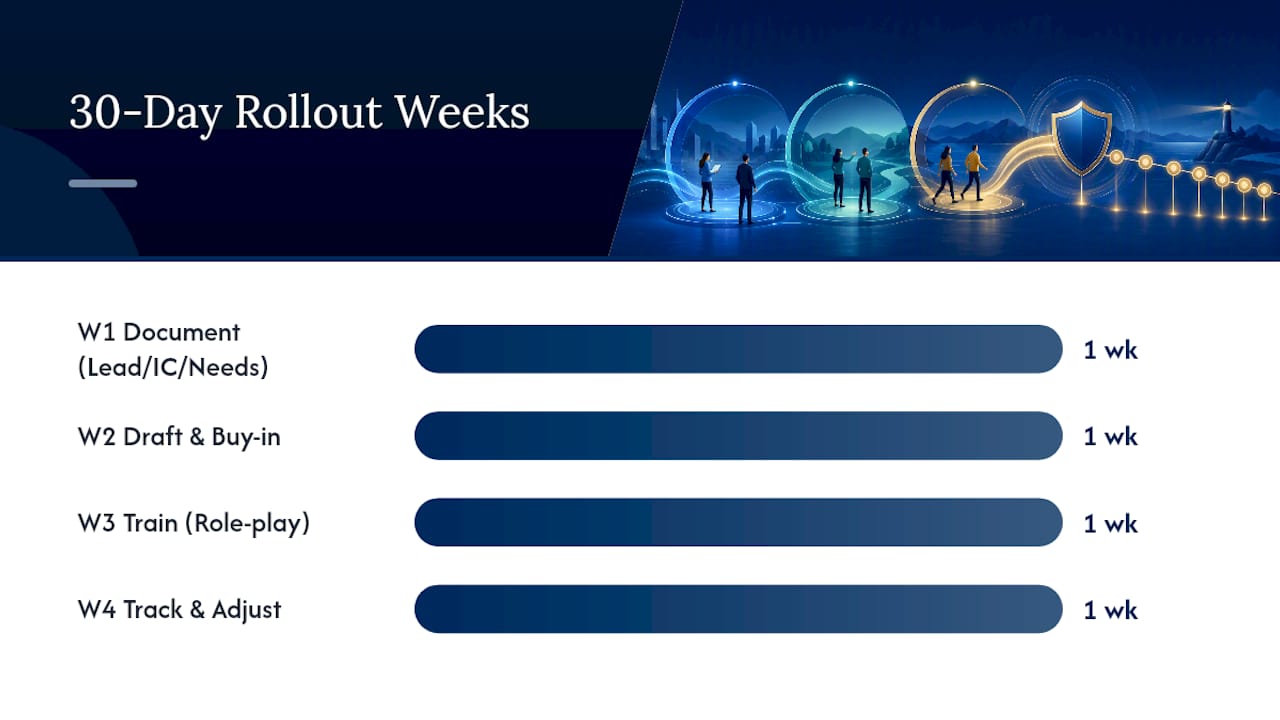
A realistic 30-day rollout for those three stages looks like this: week one, document the current-state process and identify where producers diverge; week two, draft the one-page standard for each stage and get manager buy-in; week three, train the team and run live role-play against the new standard; week four, track compliance and adjust the weakest stage. PSM Brokerage’s framework suggests this incremental approach can produce a fully standardized playbook within a single quarter, stage group by stage group.
Scripts and Talk Tracks Your Producers Can Actually Use
Scripts fail when they read like a phone tree instead of a conversation. The goal is consistent structure with room for the producer’s own voice.
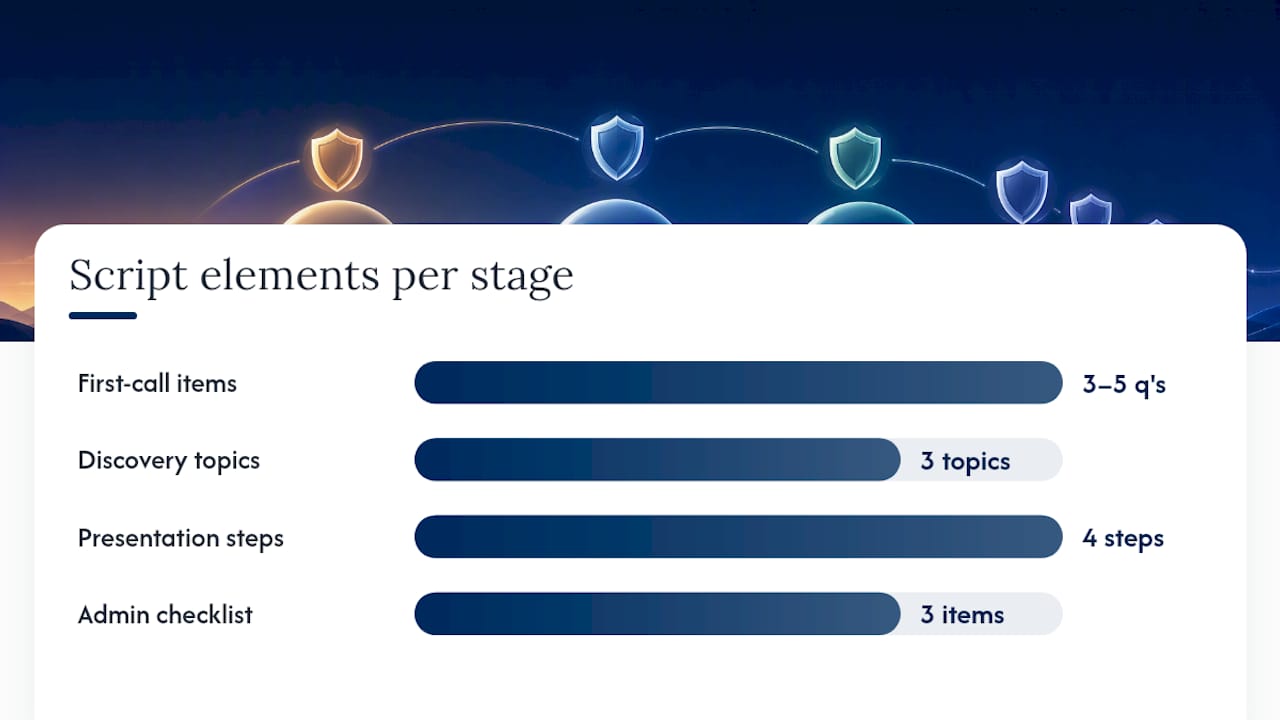
A workable first-call script covers:
- An opener that states who you are and why you’re calling, tied to the lead source.
- Three to five qualifying questions covering current coverage, timeline for a decision, and budget range.
- A transition line that earns the next step: “Based on what you’ve told me, I’d like to put together two or three options. Does Tuesday or Wednesday work better for a 20-minute call?”
Discovery is where order takers get separated from advisors. A structured discovery script asks about life changes (new home, new child, business growth), current pain points with existing coverage, and what “good coverage” would actually look like to this specific prospect. Skip this step and your presentation becomes a generic pitch instead of a tailored recommendation.
Presentation flow should follow a fixed order: recap needs, present two to three options ranked by fit rather than price, explain the tradeoffs plainly, and ask a direct closing question. An administrative close checklist, confirming beneficiary details, payment method, and effective date, prevents the single biggest source of post-sale rework.
Proposal templates should present two to three options, never five or six, formatted side by side so coverage and price differences are immediately visible. Sequencing outreach around renewal windows and major life events also improves how these scripts land, since timing changes how receptive a prospect is to the conversation in the first place.
Getting New Producers to Full Ramp Faster
A 30/60/90 plan turns “get up to speed” into something you can actually measure.
- Days 1 to 30: Shadow calls, learn the playbook stages, hit a minimum of 20 qualified conversations logged in the CRM.
- Days 31 to 60: Run solo calls with manager review, reach a target quote volume, and complete weekly role-play sessions against the objection scripts.
- Days 61 to 90: Carry a full pipeline, hit an early bind-rate benchmark, and pass a final competency review with a manager.
Role-play and simulation belong in the schedule from week one, not as an afterthought before a producer goes live. Manager-run call simulation programs show measurable reductions in ramp time and better recall of talk tracks when producers practice repeatedly before facing real prospects.
Pro Tip: Run 15-minute simulation drills every Monday during the first 90 days. Score each one against a simple rubric (opener, qualifying questions, objection handling, close) and track whether the score improves week over week.
Managers should shadow every new producer’s first ten calls, then shift to spot-checks by day 45. A written 90-day checklist keeps this consistent across managers instead of depending on who remembers to do it.
The Metrics That Tell You What to Fix First
You cannot standardize seven stages at once, so metrics are what tell you which three matter most right now.
- Speed-to-lead, measured in minutes from lead capture to first contact attempt, tracked because reply and conversion rates drop steeply once response time crosses the ten-minute mark.
- Quote-to-bind ratio, the percentage of quotes that become issued policies, the single clearest signal of presentation and close quality.
- Stage conversion rates, tracked at every one of the seven handoffs to isolate exactly where prospects drop out.
- Policies per household, a direct measure of cross-sell effectiveness.
- Retention rate, because a playbook that wins new business while losing renewals is solving the wrong problem.
Build your dashboard in three layers: a daily producer view showing calls made and speed-to-lead, a weekly executive summary showing the full funnel with conversion percentages at each stage, and a monthly retention and cross-sell report. When one stage’s conversion rate sits well below the others, that’s your next standardization target, not whichever stage feels broken anecdotally.
Tools That Enforce the Playbook Without Replacing Your Systems
The playbook comes first. Tools exist to make the standard hard to skip, not to become the standard themselves.
A minimum viable stack includes a CRM built for fast logging so lead capture actually happens within your five-minute window, a dialer or power dialer to hit response-time targets at volume, automation for follow-up sequences and proposal generation, and reporting that rolls up into the dashboard layers described above.
Integration patterns matter more than any single tool’s feature list:
- Keep the CRM as the single source of truth, with every stage transition logged there.
- Use auto-pop triage so new leads route to an available producer instantly, preserving your speed-to-lead standard.
- Build call pops that surface the relevant talk track the moment a producer answers, cutting the guesswork out of stage two.
- Run every outbound sequence through TCPA and Do Not Call compliance checks automatically, before a producer ever dials.
Pick tools that solve your specific gap, whether that’s ramp time, speed, or compliance risk, and that connect to what you already run rather than forcing a rebuild. A connected CRM that sits on top of existing workflows tends to get adopted faster than a platform that demands you start over.
How One Agency Scaled Without Breaking Compliance
Customer examples illustrate what happens when a documented playbook gets paired with automation instead of staying stuck on paper. Some agencies have scaled from a dozen producers to nearly two hundred while keeping response-time standards and compliance intact, an outcome built on process discipline first and tooling second.
Practical patterns from that kind of scaling:
- Dial volume per producer increases through predictive dialing, without adding headcount to hit the same call targets.
- Response-time SLAs get enforced automatically through routing rules rather than relying on a producer’s memory.
- Lead routing and TCPA/DNC compliance checks run before a call connects, not as an afterthought during an audit.
The adoption sequence matters here: document the process standards first, then bring in platform automation to enforce them at scale. Vendors that try to sell you a process you never defined tend to produce compliance gaps, not growth.
Building Compliance Into the Playbook, Not Bolting It On
Insurance sales sits under more regulatory scrutiny than most industries selling to consumers by phone, and a playbook that treats compliance as a separate department’s problem usually fails the first real audit.
TCPA governs how and when you can contact prospects by phone or text, and it applies at the lead capture and initial contact stages specifically, before a producer says a single word about coverage. Every outbound sequence, not just cold calls, needs a Do Not Call scrub and documented consent trail baked into stage one of your process map. This isn’t optional infrastructure you add later. It belongs in the same one-pager that defines your five-minute logging standard, because both rules govern the exact same moment in the sales cycle.
State-level licensing and appointment rules add another layer: a producer quoting a product they aren’t licensed to sell in that state creates real exposure, so your CRM or routing logic should flag license status before a lead ever reaches a producer’s queue. Needs analysis and presentation stages carry their own requirements too, particularly around suitability standards for annuities and certain life products, where documentation of the client’s stated needs has to exist before the sale closes, not after.
Build compliance checkpoints into the same one-page stage standards you’re already writing, rather than maintaining a separate compliance manual nobody reads. A checkpoint at lead capture, another at needs analysis, and a final one at submission covers the moments where most regulatory exposure actually lives.
Why the Best Playbooks Stay Boring on Purpose
The agencies that get the most out of a playbook are usually the ones who resist the urge to make it comprehensive. A master document that tries to cover every edge case becomes the document nobody opens, while a one-page-per-stage version gets used because it takes ten seconds to check.
Adoption is a leadership problem before it’s a documentation problem. Producers follow a standard when managers visibly follow it too, when metrics get reviewed weekly instead of quarterly, and when the playbook changes fast when something clearly isn’t working. A version that never gets updated after the first rollout tells your team it was never meant to be used.
Start small on purpose. Pick one metric, speed-to-lead is usually the easiest to move, and commit to improving it over the next 30 days. Measure it, adjust the stage standard that’s causing the leak, and repeat with the next metric. That cycle, not a perfect document, is what actually builds a scalable sales operation.
— Marc
Turning This Playbook Into Daily Practice With RevRing
Documenting the process is the easy part. Enforcing a five-minute lead response standard by hand, across a growing team, is where most agencies quietly give up. RevRing exists to close that gap: its predictive dialer, CRM connectivity, and industry-tailored workflows are built to enforce the exact standards this playbook lays out, speed-to-lead, stage tracking, TCPA and DNC compliance, without asking you to rip out systems you already use.
If your team is still hitting the right numbers with spreadsheets and manual dialing, building your own enforcement layer might be the right call for now. If speed-to-lead is slipping, compliance documentation is inconsistent across producers, or you’re trying to ramp new hires faster than your managers can shadow them, that’s usually the point where dedicated infrastructure pays for itself. RevRing’s plans start with Starter at $39.99 per month per seat, scaling up through Scale, Pro, and Enterprise tiers as your producer count grows.
Check the how RevRing works page to see how the dialer, CRM, and compliance layer connect to the seven-stage process, then compare plans on the pricing page to find the tier that matches where your team is right now.
Primary Sources and Further Reading
- PSM Brokerage’s standardization framework: the source for the seven-stage process and incremental rollout advice.
- FirstSales’ insurance funnel guide: timing and multi-touch sequencing benchmarks.
- Leadhaste’s prospecting guide: ICP targeting for outreach.
- Insurance Journal on playbook construction: document-length and adoption pitfalls.
Sources
- How to standardize your insurance sales process — PSM Brokerage
- Sales funnel for insurance — FirstSales
- Insurance Sales Prospecting Guide 2026 — Leadhaste
- Create a Sales Playbook — Insurance Journal
FAQ
What Should Be Included in a Sales Playbook?
A usable playbook includes a one-page process map per product line, per-stage standards, talk tracks, objection scripts, proposal templates, onboarding checklists, and clear KPI definitions. Keep the master document short, one page per stage, and push detailed scripts and compliance language into supporting documents so the core playbook stays something people actually open.
What Are the Best Books for Insurance Sales?
There’s no single canonical list, and quality varies by what you’re trying to fix, prospecting, objection handling, or leadership. Rather than chasing a specific title, prioritize resources that address your weakest stage in the seven-stage process, whether that’s discovery questioning or closing technique, and pair reading with real role-play practice.
What Kind of Insurance Sales Makes the Most Money?
Commercial lines and complex products like life insurance with cash-value components generally carry higher commissions per sale than simple auto or renters policies, but volume-based lines can outearn them through repeat business and cross-selling. The bigger driver of income is usually process discipline, hitting speed-to-lead targets and stage conversion benchmarks, rather than which product line an agent chooses.
Why Do Most Insurance Agents Quit?
Slow ramp time is the most common reason: producers who don’t reach a productive pipeline within their first 90 days often burn out or leave before the business pays off. A structured 30/60/90 onboarding plan with role-play benchmarks and manager shadowing shortens that ramp and gives new agents visible proof of progress early, which meaningfully improves retention.
How Much Does RevRing Cost for an Insurance Agency?
RevRing’s Starter plan begins at $39.99 per month per seat, with Scale and Pro tiers priced higher as feature needs grow, and Enterprise pricing available on request. A standalone CRM-only option is also available at $70 per month per seat for agencies that only need that piece of the stack.