10 Step TCPA Checklist for U.S. Outbound Teams

Prior express written consent, naming the seller and disclosing autodialed or prerecorded contact, is non-negotiable before you call or text a mobile number for marketing purposes. Every outbound program needs four controls running at all times: consent logging with an audit trail, National Do Not Call scrubs, opt-out processing within 10 business days, and calling-hour enforcement. Layer in state mini-TCPA rules, and the margin for error shrinks fast.
TL;DR:
- Consent must disclose the seller’s identity and must be obtained through an affirmative action, such as a signed document or checked box, with no pre-checked options.
- DNC scrubs should be performed at least every 31 days using the national registry, internal suppression lists, and applicable state registries, with real-time checks before each dial batch.
- Opt-out requests must be processed within 10 business days across all communication channels, and opt-outs should propagate instantly to prevent violations.
- All consent and call records, including timestamps, IP addresses, and disclosure language, should be retained for at least five years to support potential legal audits or demand requests.
- The calling platform must automatically enforce compliance rules through built-in controls like consent capture, scrubbing, opt-out sync, and time-zone-aware dialing, minimizing manual errors at scale.
Table of Contents
- What Does TCPA Compliance for Outbound Calling Actually Require?
- How Do You Operationalize These Rules Across Systems?
- What Records Do You Need to Survive a TCPA Audit or Demand Letter?
- How Should Your Platform Enforce the TCPA Checklist?
- 10-Step Pre-Campaign Compliance Check
- Why Compliance Design Beats Compliance Policing
- Put Compliance Controls on Autopilot With Revring
- Sources
- FAQ
What Does TCPA Compliance for Outbound Calling Actually Require?
The Telephone Consumer Protection Act bars autodialed or prerecorded marketing calls and texts to cell phones without prior express written consent, and it requires prerecorded messages to identify the caller. State law can go further, and several states already do. Here’s the priority order for fixing gaps before they become lawsuits.
- Validate consent language. Every opt-in needs the seller named and clear disclosure that automated calls or texts may follow, and an affirmative action, a checked box or signature, not a pre-checked default.
- Run DNC scrubs on a fixed cadence. Scrub against the National DNC Registry at least every 31 days, plus your internal suppression list and any state registries that apply to your calling territory.
- Process revocations promptly, ideally within two weeks. Under current FCC rules, consumers can revoke consent by any reasonable means, a text reply, a verbal request, an email. You have up to 10 business days to honor it across every channel.
- Enforce calling windows. The general permitted calling hours are during the day and evening within local time zones for recipients. Some states cut that window shorter or add day-of-week restrictions.
- Vet every lead vendor. Before you dial a purchased list, confirm the consent language matches your campaign and secure contractual indemnity if it doesn’t.
Vendor risk deserves its own line item. A vendor who can’t produce a sample opt-in with timestamp, IP address, and disclosure text within a day or two is a warning sign worth escalating, not negotiating around.
- Named seller disclosed at point of consent
- Affirmative action captured (no pre-checked boxes)
- Consent record includes timestamp, IP, and exact language shown
- Vendor contract includes indemnity for invalid consent
How Do You Operationalize These Rules Across Systems?
Legal requirements only matter if your tech stack enforces them without relying on an agent remembering the rule. That’s the real shift outbound teams need to make: push compliance into platform defaults, not training decks.
Your consent audit trail should capture, at minimum:
- Exact disclosure language shown to the consumer
- Timestamp with time zone
- IP address and capture URL (or operator ID for verbal consent)
- Signed or checked-box confirmation
Make this record immutable. Once written, it should never be editable, only appendable, so it holds up as litigation evidence years later.
Scrubbing needs its own workflow discipline. High-volume teams often run a weekly full-list scrub against DNC registries and a real-time scrub immediately before each batch goes out, catching numbers that opted out between the last full scrub and today’s dial session. Pair that with a reassigned-number database check so you’re not calling a consumer who inherited a number from someone who once consented.
Opt-outs need to propagate everywhere at once. A request through SMS has to suppress voice dialing too, and vice versa. Operational controls that tie opt-outs into suppression lists across channels prevent the exact scenario that generates class actions: a consumer who revoked consent on one channel getting dialed on another. Watch three KPIs weekly: abandonment rate, scrub frequency versus schedule, and opt-out processing promptly.
Pro Tip: Set an internal SLA of 24 hours for opt-out processing, even though the legal deadline is 10 business days. The buffer protects you when a request gets routed through an unexpected channel.
What Records Do You Need to Survive a TCPA Audit or Demand Letter?
Statutory damages can be substantial per negligent or willful violation(https://www.nice.com/glossary/tcpa), and class actions multiply that fast when a single bad list touches thousands of numbers. Recordkeeping is usually what decides these cases, not the underlying facts.
Industry practice recommends retaining consent records and call detail records for multiple years to cover potential discovery periods(https://leadcompliant.com/articles/tcpa-basics/tcpa-compliance-checklist-2026), long enough to cover realistic statute-of-limitations windows and discovery requests. Keep these on hand and ready to export:
- Consent logs (disclosure text, timestamp, IP, capture method)
- DNC scrub logs (date run, registry version, record count)
- Opt-out and revocation logs with propagation timestamps across channels
- Vendor consent samples and indemnity agreements
When a demand letter arrives, the requesting attorney typically wants the exact consent record tied to the specific number and date in question. If you can produce it in an hour instead of a week, you’ve already changed the tone of that conversation. Run periodic spot-checks on vendor consent samples and QA verbal consent scripts against your recorded calls, and require every lead seller to contractually guarantee retention and indemnity for invalid opt-ins.
How Should Your Platform Enforce the TCPA Checklist?
Manual compliance breaks down at scale. The dialer and messaging platform need to be the first line of defense, not the agent’s memory. A platform built for regulated outbound work should handle:
- Audit-ready consent capture tied directly to each contact record
- Automated DNC scrubs on a fixed schedule plus real-time pre-dial checks
- Opt-out sync across voice, SMS, and CRM in real time
- Time-zone-aware dialing that blocks calls outside the local calling window
- Reassigned-number API checks before each campaign launch
- Exportable compliance reporting for audits and demand letters
Revring builds these controls into its predictive dialer and CRM connectivity so compliance defaults ship with the platform rather than getting bolted on later. Insurance, real estate, and healthcare teams each carry different regulatory overlays. Revring’s healthcare-specific compliance guidance covers the added layer of HIPAA business associate obligations that stack on top of TCPA rules for patient outreach.
Some clients have scaled from a dozen agents to hundreds without losing suppression hygiene, a real test of whether opt-out and DNC controls hold up under growth rather than falling apart at volume. That’s the practical proof point: automation that enforces the checklist consistently, whether you’re running a small team or scaling into hundreds of seats.
10-Step Pre-Campaign Compliance Check
Run this before any outbound push, in 30 to 90 minutes:
- Spot-check 10 recent consent records for complete disclosure language
- Request a sample opt-in screenshot from your lead vendor
- Run a fresh DNC scrub against national, state, and internal lists
- Test the opt-out flow end-to-end across voice and SMS
- Confirm calling-hour rules are set correctly for every time zone you’re dialing
- Run a reassigned-number check against your active list
- Pull a retention snapshot to confirm logs are exporting properly
- QA one verbal consent script against a recorded call
- Check abandonment rate against your last three campaigns
- Confirm you can produce a full evidence packet for one random contact in under an hour
Escalate to counsel immediately if any consent language looks ambiguous or a state’s mini-TCPA rule conflicts with your default settings.
Why Compliance Design Beats Compliance Policing
Most outbound teams treat TCPA compliance as a training problem: teach agents the rules, hope they follow them. That’s backwards. The programs that stay out of litigation build compliance into the platform so no single agent decision can create a violation.
Industry playbooks exist because generic dialer settings don’t account for the fact that a real estate team’s calling patterns and a healthcare intake team’s consent requirements aren’t the same problem. Treat compliance as operational design, not a policy memo, and it stops being a drag on revenue. It becomes the reason your calling channels stay open while competitors get shut down by a single bad list.
— Marc
Put Compliance Controls on Autopilot With Revring
Reading a checklist is one thing. Running it across thousands of daily dials without a dropped scrub or a missed opt-out is another problem entirely, and it’s the one Revring was built to solve.
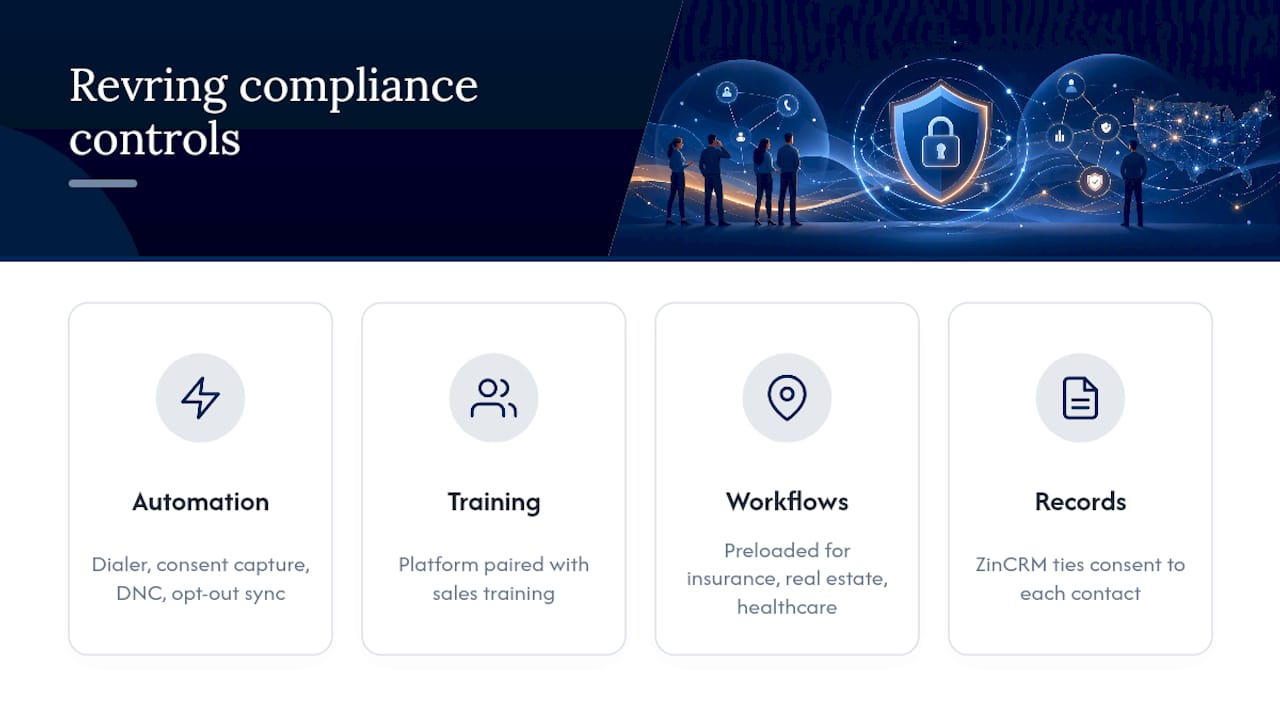
Revring’s platform pairs a predictive dialer with automated consent capture, DNC scrubbing, and cross-channel opt-out sync, so your compliance defaults are built into the calling infrastructure instead of living in a training manual nobody rereads. Agent scripts and cadence still matter, and pairing platform automation with sales training that actually reinforces compliant scripts closes the gap between what the system enforces and what agents say on the call. Industry-specific workflows for insurance, real estate, and healthcare teams come preloaded, and ZinCRM keeps consent records tied directly to each contact so nothing gets lost between systems.
One honest note: platform controls handle the operational side, but interpreting a specific state’s mini-TCPA rule or responding to an active demand letter still calls for legal counsel. Revring’s tools are built to make that conversation shorter, not to replace it.
Ready to see the controls in action? Request a compliance-focused demo and walk through how your outbound program would run on Revring’s infrastructure.
This article is general information, not a substitute for advice from a qualified lawyer. Consult a qualified legal professional about your own circumstances before acting on anything here.
Sources
- Telephone Consumer Protection Act (TCPA) rules — FCC
- TCPA compliance checklist 2026: what outbound teams must do… | LeadCompliant
- TCPA Compliance for Outbound Sales: 2026 Complete Guide | BelSmart
FAQ
What Counts as Prior Express Written Consent?
It requires the seller named, clear disclosure that autodialed or prerecorded calls or texts may follow, and an affirmative action like a signature or checked box, not a pre-checked default.
How Often Should You Scrub Against the National DNC Registry?
Industry practice calls for scrubbing at least every 31 days, plus real-time checks against internal suppression lists before each dial batch.
How Fast Must You Process an Opt-Out Request?
Current FCC rules require honoring revocation within 10 business days across every channel the consumer used or any reasonable method they chose.
What Are the Allowed Calling Hours Under the TCPA?
The general permitted calling hours are during the day and evening within local time zones for recipients, though several states set narrower windows or add extra restrictions.
Can a Platform Like Revring Prevent TCPA Violations Automatically?
Revring’s dialer and CRM connectivity enforce consent capture, DNC scrubs, and cross-channel opt-out sync as platform defaults, reducing the reliance on manual agent compliance without replacing legal judgment on edge cases.
How Long Should You Keep TCPA Consent Records?
Guidance recommends retaining consent records for at least five years and call detail records for at least four to match realistic litigation and discovery windows.